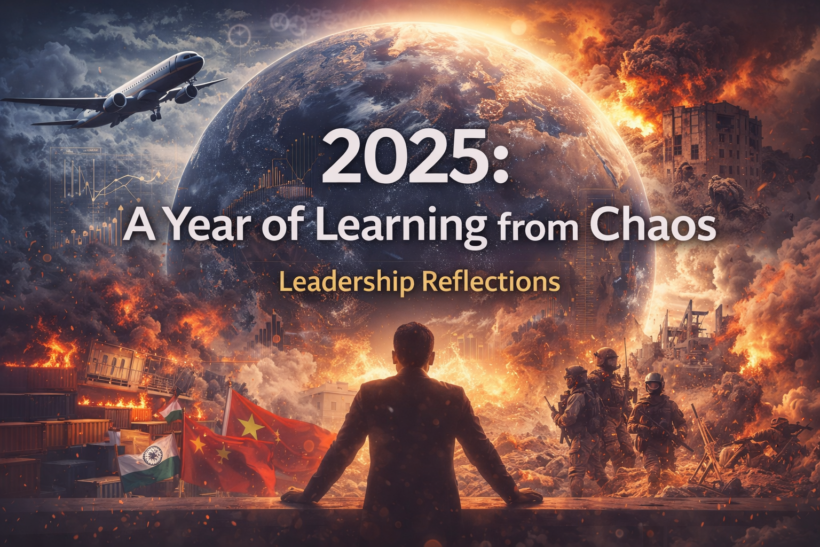

2025 a Year of learning from Chaos, change of systems, world rankings!
This year, it has been with numbers of events and things.
US tariffs, Indigo crisis, Ukraine and Russia War, Gaza situation in war, India Pakistan-Operation Sindoor, sudden increase in silver demand and so many more.
Although the number of events were not happy events and were sad events.
However, the right leadership measure comes with stressful and tough times.
Have you ever thought what kind of leadership attributes you showed, at the time of your own tough times.
Let`s give a reality check, how different leaders took tough times, as challenge and came out as strong in tough times.
United States Tariff Pressure
When the United States imposed tariff pressure, the responses from India and China offered two contrasting yet powerful leadership lessons. India leaned toward calibrated diplomacy—protecting domestic industries while keeping negotiation channels open—while China chose strategic firmness, absorbing short-term pain to strengthen long-term self-reliance. Together, their approaches against United States tariffs show that effective leadership is not emotional or reactive, but deliberate and identity-driven.
What leadership taught us from these responses:
-
Clarity over reaction: Both countries avoided impulsive decisions under pressure.
-
Alignment with identity: India emphasized balance and credibility; China emphasized endurance and strategic depth.
-
Long-term thinking: Short-term discomfort was accepted to protect future leverage.
-
Calm under pressure: Neither response was driven by headlines or public noise.
-
Choice of strategy: Leadership is about choosing how to respond, not just whether to respond.
These lessons apply beyond geopolitics: strong leaders stay grounded, think in decades, and act in ways consistent with who they are—not what the moment provokes.
Strong leadership is not about reacting to pressure; it is about responding in alignment with long-term purpose.
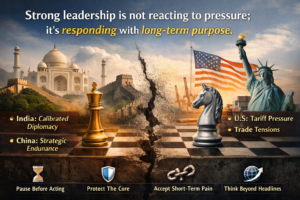
What one should learn from this:
-
Pause before acting: Pressure tests patience. Leaders who pause think better.
-
Protect the core: Decide what must be safeguarded before choosing a response.
-
Accept short-term pain: Long-term strength often requires temporary discomfort.
-
Stay emotionally neutral: Calm thinking preserves options; anger narrows them.
-
Think beyond headlines: Real leadership decisions are measured in years, not days.
Whether in business or personal life, the lesson is the same: don’t let external pressure dictate your behavior—let your values and long-term vision do that.
Indigo Crisis
The IndiGo crisis was not caused by a single failure but by the gradual buildup of stress—rapid growth, aircraft groundings, supplier dependency, and stretched operations colliding with peak demand. An efficiency-led model worked well in stable times but revealed its limits when resilience did not scale alongside size. The situation showed that even strong systems can struggle when buffers, flexibility, and communication lag behind expansion.
What leadership teaches us from this crisis:
-
Growth must be matched with resilience: Scale without buffers increases risk.
-
Efficiency is not enough: Reliable operations need redundancy and flexibility.
-
Early signals matter: Ground realities should be addressed before they compound.
-
Stability over speed: Sometimes slowing down is the fastest way to recover trust.
-
Transparent communication: Clear, honest updates calm customers and teams.
-
Long-term reliability over short-term metrics: Sustainable performance beats rapid expansion.
This is a reminder that strong leadership is not about running faster—but about building systems that hold under pressure.
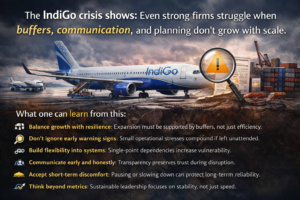
What one can learn from this:
-
Balance growth with resilience: Expansion must be supported by buffers, not just efficiency.
-
Don’t ignore early warning signs: Small operational stresses compound if left unattended.
-
Build flexibility into systems: Single-point dependencies increase vulnerability.
-
Communicate early and honestly: Transparency preserves trust during disruption.
-
Accept short-term discomfort: Pausing or slowing down can protect long-term reliability.
-
Think beyond metrics: Sustainable leadership focuses on stability, not just speed.
The broader lesson is simple: leadership is not about avoiding crises, but about building systems—and mindsets—that endure when pressure arrives.
Journey Physicswallah
The journey of PhysicsWallah reminds us that real leadership is built on purpose, not polish. In a world chasing valuation, speed, and hype, PhysicsWallah grew by staying obsessively focused on one thing—making quality education accessible and affordable. That clarity shaped every decision, from content depth to pricing discipline. Motivation here did not come from market applause, but from serving a real problem consistently, even when scaling brought pressure.
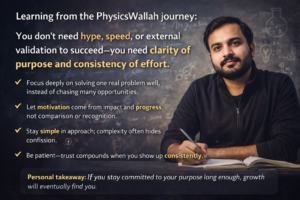
What leadership and motivation teach us from this journey:
-
Purpose creates endurance: When the “why” is strong, leaders stay grounded during growth.
-
Simplicity scales better than complexity: Clear thinking beats fancy strategies.
-
Trust compounds: Long-term credibility is built by delivering value before chasing expansion.
-
Motivation follows impact: Seeing lives change is more powerful than short-term rewards.
-
Leadership is restraint: Knowing what not to chase is as important as knowing what to pursue.
What one should learn:
-
Focus deeply on solving one real problem well, instead of chasing many opportunities.
-
Let motivation come from impact and progress, not comparison or recognition.
-
Stay simple in approach; complexity often hides confusion.
-
Be patient—trust compounds when you show up consistently.
-
Measure success by value created, not just visibility gained.
Personal takeaway:
If you stay committed to your purpose long enough, growth will eventually find you.
Closing Reflection: What 2025 Quietly Asked Us
2025 was not kind—but it was honest.
It showed us that:
-
Pressure reveals character
-
Chaos tests systems
-
Stress exposes leadership maturity
The most important question this year leaves us with is not about governments or companies—but about ourselves:
Who did you become when things were not easy?
Because in the end, leadership is not defined by calm times.
It is defined by how you respond when everything feels uncertain.

 Ankit Joshi