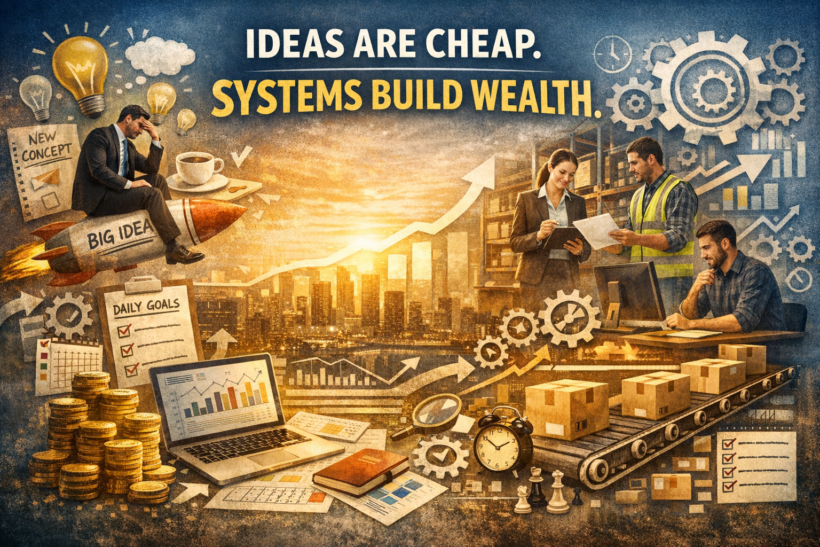

Ideas Are Cheap. Systems Build Wealth.

Walk into any office, café, or startup hub, and you will hear brilliant ideas floating in the air. Someone wants to open a second outlet, someone is planning an app that will “change everything,” and someone else has figured out how to fix a broken process in their company. Ideas are everywhere. What is rare is not imagination, but execution.
If ideas alone created wealth, every notebook would be a gold mine. The real difference between businesses that grow and those that fade is not intelligence, funding, or even timing. The difference is systems. An idea is a spark. A system is what keeps the fire burning long after excitement fades.

A small D2C brand in Bengaluru once had a product customers genuinely loved. Reviews were strong, repeat interest was high, and the founder was capable. Yet the business struggled to survive because orders were always late, inventory was mismanaged, and every shipment felt like a crisis. There was no defined order flow, no dispatch routine, and no daily operating rhythm. Customers left, refunds increased, and cash flow collapsed. The idea did not fail. The absence of a system did.
Ideas feel powerful because they cost nothing and make us feel smart. They arrive in the shower, during walks, or in meetings, giving us a rush of possibility. But ideas do not create habits. They do not remove friction. They do not survive bad days. They do not scale when growth arrives.
A gym owner may dream of building a premium fitness brand, but without a structured onboarding process, regular follow-up with members, and a renewal system, that dream remains a poster on the wall. A startup may design a powerful AI product, but without a lead pipeline, sales cadence, and customer success loop, it becomes just another pitch deck.

Look at companies that endure. Amazon’s wealth is not built on a clever retail idea. It is built on logistics systems that move millions of packages daily with predictable speed. Toyota’s dominance is rooted in the
Toyota Production System, which removes waste and defects at every step. McDonald’s consistency comes from kitchen systems that work the same across continents.
Wealth grows through three forces: consistency, scale, and time. Ideas offer none of these. Systems offer all three. A blogger who writes only when inspired may publish twice a month. Another blogger with a simple content system—fixed days, fixed topics, fixed workflow—publishes twice a week. After one year, one has written twenty-four posts, while the other has written over a hundred. Traffic compounds, authority builds, and income follows. The talent was the same. The structure was not.
That is why mature organizations invest in playbooks, checklists, and routines. They make success boring—and boring is profitable.
Motivation is emotional. Systems are mechanical. Motivation depends on mood, sleep, and stress. Systems depend on clocks. You do not wait to feel inspired to brush your teeth; you do it because it is embedded in your routine. Wealthy individuals design life the same way. They automate savings, schedule investments, and create fixed learning routines using tools like
Notion,
Trello, and
Zapier.
James Clear explains this powerfully in Atomic Habits, where he shows how small systems outperform big goals.

To build your first system, choose one area—money, work, content, or health. Define the outcome you want, decide one daily action, fix a time for it, choose a way to track it, and set a review rhythm. Write it down. Make it visible. Use alarms and checklists. Do not trust memory. Design routines that survive bad days.
Most people live reactively. Email sets the day. Urgency kills goals. Mood drives action. Systems flip control. You decide first. You act first. You lead yourself. That is real power—not hustle, not speed, but design.
Ideas inspire rooms. Systems build companies. Ideas start fires. Systems build cities.
If you want wealth, do not chase brilliance. Design structure. Build a machine. Run it daily. Let time work for you.
Ideas are cheap. Systems build wealth.
All images used are royalty-free from Unsplash.


 Ankit Joshi