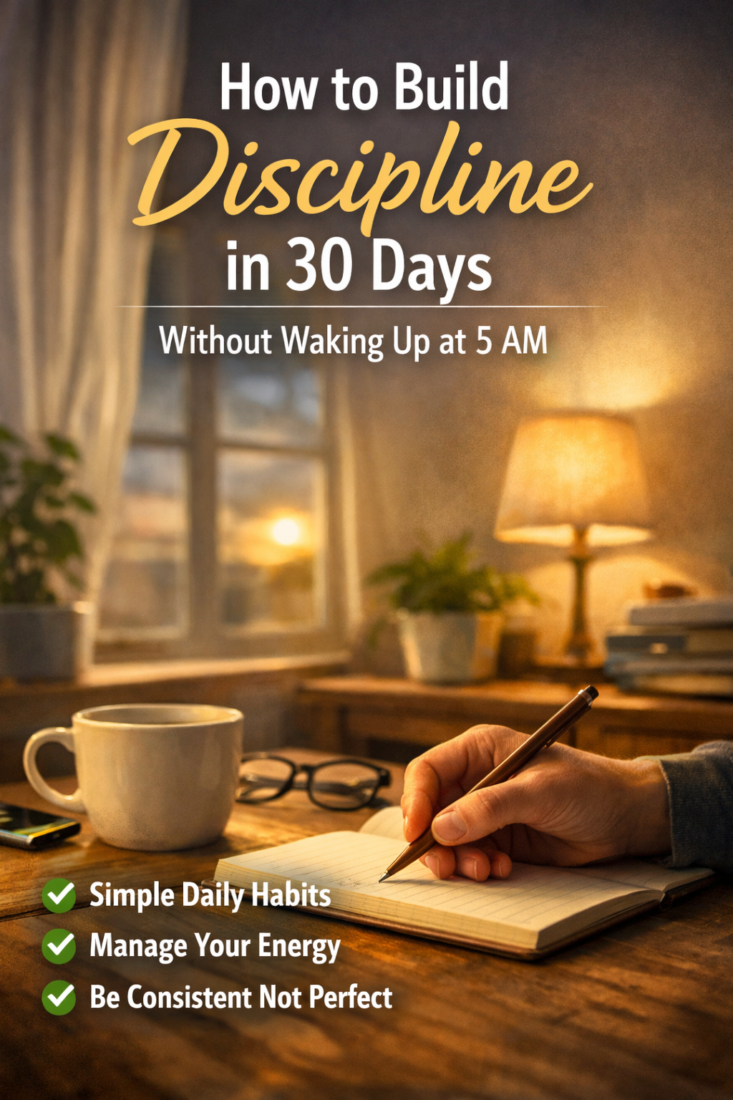

How to Build Discipline in 30 Days Without Waking Up at 5 AM
Most advice about discipline sounds extreme. You are told to wake up before sunrise, follow rigid routines, and push harder every day.
For some people, this works. For most people, it quietly fails.
Not because they are lazy or unmotivated, but because real life is full of responsibilities, uneven energy, and mental fatigue.
True discipline is not built through dramatic routines. It is built through small, repeatable actions that you can sustain even on ordinary days.

Why Most Discipline Advice Does Not Last
The biggest mistake people make is believing that discipline requires constant motivation. Motivation feels powerful when it appears, but it disappears the moment life becomes demanding.
Real life does not offer perfect conditions. Energy fluctuates. Some days feel focused, while others feel heavy.
Discipline that depends on ideal conditions collapses quickly.
Research in behavioral psychology shows that habits built on consistency outperform habits built on motivation.
You can explore this further through the work of BJ Fogg on behavior design:
BJ Fogg Behavior Model.
Why Waking Up at 5 AM Is Not the Solution
Waking up early is often mistaken for discipline. In reality, it is a personal preference.
Some people think clearly in the morning. Others perform better later in the day.
Forcing yourself into a routine that fights your natural rhythm creates frustration, not discipline.
Discipline is not about when you act. It is about whether you follow through consistently.

Discipline Is Built on Energy, Not Willpower
Willpower is limited. It fades as the day progresses.
Energy, however, can be managed.
Most people plan their days assuming they will feel the same throughout the day. This assumption leads to burnout.
Energy-aware discipline adjusts effort instead of forcing performance.
Harvard Health explains how mental energy affects decision-making and self-control:
Harvard Health – Self Control and the Brain.
The 30-Day Approach: Small Commitments That Build Trust
The purpose of the next 30 days is not transformation. It is rebuilding trust with yourself.
Trust grows when you consistently do what you promised yourself, even when the action feels small.
Choose one commitment that feels manageable on your worst day.
Ten minutes of focused work, a short walk, a few pages of reading, or a small writing habit are enough.

Why Small Commitments Work
Large goals trigger resistance and delay. Small actions feel safe.
When a task feels easy, the brain does not negotiate. It simply starts.
Each completed action strengthens self-trust. Over time, discipline stops feeling forced and starts feeling natural.
Handling Low-Energy Days Without Breaking Discipline
Low-energy days are unavoidable. They are not signs of failure.
On such days, reduce effort but never remove action.
If ten minutes feels heavy, do five. If five feels heavy, do two.
Never choose zero.
Psychologists call this the “minimum viable habit.” You can read more about this concept here:
James Clear – Habit Formation Guide.

Designing an Environment That Supports Discipline
Discipline becomes easier when your environment supports it.
If distractions are visible, they pull attention. If tools are hidden, starting feels harder.
Place what matters in sight. Reduce friction where possible.
This is not about being strong. It is about being intentional.
Why Energy Management Beats Time Management
Time management assumes every hour has equal value. Energy management understands that this is not true.
Some moments are naturally focused. Others are better for lighter tasks.
Placing your discipline habit in a high-energy window increases consistency without stress.
From Intensity to Rhythm
Many people confuse discipline with intensity. They push hard at the start and burn out quickly.
Discipline grows through rhythm. Showing up consistently, even when effort feels ordinary, creates stability.
Stability is what allows habits to survive long-term.

Why Self-Respect Matters More Than Control
Discipline driven by shame does not last. Discipline driven by self-respect does.
When you respect your energy, your time, and your limits, discipline feels supportive instead of controlling.
You are no longer punishing yourself into progress.
Accepting Boredom as Part of Growth
Discipline is repetitive by nature. It rarely feels exciting.
Reading daily, practicing basics, and showing up consistently can feel boring.
Boredom is not a problem. It is the environment where mastery grows.
What Changes After 30 Days
After 30 days, discipline feels quieter.
You trust yourself more. You hesitate less. You stop negotiating with yourself.
This is not a dramatic transformation. It is a stable foundation.
And stable foundations support long-term growth.

Final Reflection
You do not need extreme routines or early mornings to become disciplined.
You need honesty, consistency, and respect for your energy.
Discipline grows when you become reliable to yourself.
Build it slowly. Protect your energy. Show up daily.


 Ankit Joshi