
The Real Barrier to Success Is Not Ability but Courage
Many people spend years believing that success belongs only to the most talented individuals in society. They assume that great leaders, innovators, and entrepreneurs succeed because they possess extraordinary intelligence, exceptional education, or unique natural abilities that others simply do not have. This belief has been repeated so often that it has quietly become one of the most accepted myths in modern professional life.
However, when we look closely at the stories of successful individuals across industries, we discover something surprising. Their greatest advantage was rarely superior ability. Instead, their defining quality was the courage to act when others hesitated.
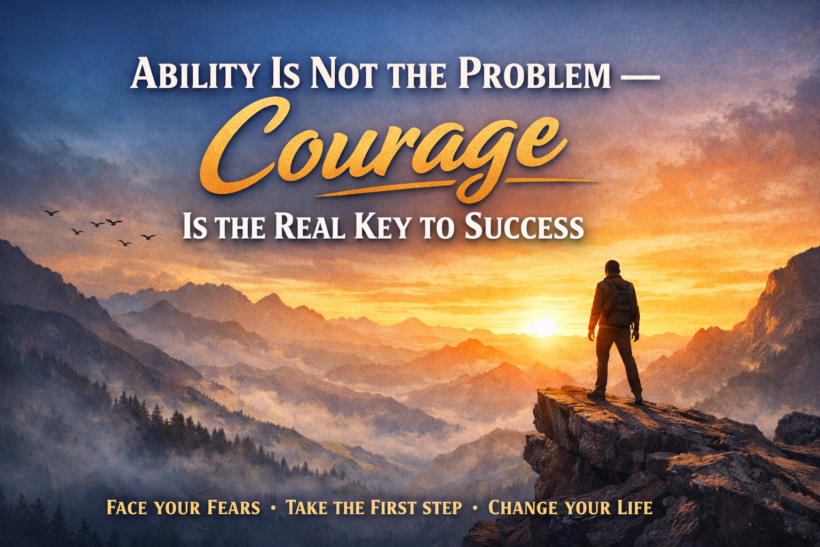
The truth is simple but powerful: the problem is rarely ability. The real problem is courage.

The Dangerous Myth of Talent
Society often glorifies the idea of natural talent, which creates the illusion that successful people are fundamentally different from everyone else. This myth makes many capable individuals underestimate their potential and assume that greatness is reserved only for a special group of gifted people.
In reality, research on human performance repeatedly shows that skill and mastery are built through consistent practice, experimentation, and learning from failure. The famous psychologist Angela Duckworth describes this concept as “grit,” which represents the combination of passion and perseverance that allows individuals to continue working toward long-term goals even when progress feels slow or uncertain.
You can explore more about this research here:
Angela Duckworth – The Science of Grit
The lesson is clear. Talent may provide a starting point, but courage determines whether that talent is ever used.
A Simple Story That Explains Everything
Imagine two young professionals who graduate from the same engineering college and start their careers in similar organizations. Both individuals have similar grades, comparable technical skills, and a strong theoretical understanding of their field.
The first professional constantly waits for the perfect moment before taking initiative. He spends months studying new tools, preparing ideas, and analyzing every possible outcome before presenting his thoughts to senior leaders. His intention is good, but hesitation prevents him from taking meaningful action.
The second professional approaches his career differently. He understands that learning happens through experience, so he begins proposing small improvements in team meetings, volunteering for difficult assignments, and experimenting with new solutions even when he does not feel completely ready.
Five years later, the difference between them becomes obvious. The first professional remains competent but relatively invisible in the organization. The second professional has gained confidence, leadership exposure, and a reputation for solving problems.
Their abilities were similar at the start, yet their outcomes are dramatically different. The reason is not intelligence or education. The reason is courage.

Why Courage Is More Important Than Ability
Courage Converts Ideas Into Action
Ideas alone rarely change the world because ideas exist everywhere. What truly creates progress is the willingness to turn ideas into action even when success is uncertain and failure remains a real possibility.
Many people have brilliant ideas but hesitate to implement them because they worry about criticism, rejection, or the possibility of making mistakes. Courage allows individuals to move beyond this hesitation and transform ideas into real outcomes.
Courage Builds Ability Over Time
One of the most misunderstood aspects of success is the belief that ability must exist before action. In reality, ability often develops because of action. Each attempt creates learning, and each mistake provides insight that improves the next attempt.
The famous “10,000-hour rule,” popularized by Malcolm Gladwell, highlights how mastery emerges from sustained effort and deliberate practice rather than natural talent alone.
You can read more about deliberate practice here:
Harvard Business Review – The Making of an Expert
Courage Helps People Overcome Fear
Fear is a natural human response to uncertainty, especially when outcomes are unpredictable or stakes feel high. Even highly accomplished leaders experience moments of doubt before making major decisions.
The difference between those who move forward and those who remain stuck lies in their response to fear. Courage does not eliminate fear, but it allows individuals to act despite the presence of fear.

The Hidden Cost of Playing Safe
Choosing safety and comfort may appear sensible in the short term because it reduces the likelihood of visible failure. However, this approach carries a hidden cost that many people do not recognize until years later.
When individuals avoid taking risks, they also avoid discovering their true potential. Ideas remain unexplored, innovations remain untested, and opportunities quietly pass by.
Many professionals eventually realize that their greatest regret is not failure but the absence of attempts. They realize that their abilities were never the real limitation; the limitation was the courage required to use those abilities.
Courage in Leadership and Business
Leadership environments demand courage on a daily basis because leaders must make decisions with incomplete information while balancing multiple stakeholder expectations. Every strategic decision involves uncertainty, and every meaningful change involves risk.
Organizations that thrive in competitive industries often have leaders who are willing to experiment, learn quickly from mistakes, and adapt strategies based on real-world feedback.
According to research from McKinsey & Company, organizations that embrace experimentation and calculated risk-taking are significantly more likely to achieve long-term innovation and sustainable growth.
Resource:
McKinsey – The Innovation Commitment
How Anyone Can Develop Courage
Courage is often misunderstood as a rare personality trait that only a few people naturally possess. In reality, courage behaves more like a skill that becomes stronger through repeated practice.
Start With Small Actions
Developing courage does not require dramatic life changes. It often begins with simple actions such as expressing ideas in meetings, volunteering for new projects, or taking responsibility for solving problems within a team.
Accept Imperfection
Perfectionism can quietly destroy progress because it convinces people to delay action until conditions appear flawless. Growth happens during the process of execution, not before it.
Reframe Failure as Learning
One of the most powerful mindset shifts involves viewing failure not as a final judgment but as a valuable source of feedback. Many of the world’s most successful innovators built their breakthroughs through repeated experimentation.
You can explore this concept further here:
Farnam Street – Learning From Failure

The Courage Economy of the Future
The modern economy rewards individuals who can adapt quickly, experiment with new ideas, and take initiative in uncertain environments. Technology is reshaping industries faster than ever before, which means that waiting for perfect certainty often results in missed opportunities.
Professionals who succeed in this environment are not necessarily the smartest individuals in the room. Instead, they are the individuals who consistently take action, learn rapidly, and adjust their strategies as new information becomes available.
Final Thoughts
Many capable individuals spend years doubting their own potential because they believe that success requires extraordinary intelligence or rare talent. This belief creates hesitation and prevents them from pursuing opportunities that could transform their lives.
Yet history consistently shows that ability alone rarely determines outcomes. The defining factor behind many achievements is the courage to take the first step despite uncertainty.
The next time you question whether you are capable of pursuing a meaningful goal, remember this simple idea. Your abilities may already be sufficient. What truly matters is whether you are willing to use them.
The problem is not ability. The problem is courage.


 Ankit Joshi