
Process Is Not Bureaucracy. It Is Respect for Human Time.
In most organizations, the word process carries emotional weight. It reminds people of long forms, slow approvals, rigid checklists, and meetings that lead nowhere. For many professionals, process feels like an obstacle placed between them and real work. It is seen as a tool of control rather than a tool of enablement.
This reaction is understandable. Many workplaces have experienced process in its worst form. They have seen rules created to protect hierarchy rather than people. They have lived inside systems that add steps without removing pain. Over time, “process” becomes a synonym for delay.
Yet this interpretation misses the true purpose of process.
At its best, a process is not a constraint. It is a form of care. It exists to reduce uncertainty, prevent repeated confusion, and protect people from unnecessary effort. A well-designed process quietly absorbs complexity so that humans do not have to. It allows people to spend their energy on value creation rather than on navigation.
In that sense, process is not about control. It is about respect. It respects the limited nature of human time. It recognizes that attention, energy, and focus are scarce. It accepts that people should not suffer because a system is poorly designed.
Bad processes waste human time. Good processes protect it. That difference defines the quality of leadership.
Research from Harvard Business Review shows that knowledge workers lose nearly one full day each week to inefficient coordination and unclear workflows. This loss rarely appears in financial statements. Yet it shapes daily experience. It decides whether people go home fulfilled or exhausted.
When Process Is Missing, People Pay the Price
In many organizations, the same problems repeat with painful regularity. Orders are delayed every month. Quality issues resurface every quarter. Customers raise identical complaints year after year. Meetings reopen the same topics because nothing truly changes.
Leaders often describe this as “dynamic work.” Employees describe it as exhausting.
The root cause is usually simple. There is no living process. Or there is a process, but it exists only in a document repository. It is not embedded in daily behavior.
When systems fail, people compensate. They chase information. They remind colleagues. They escalate issues. They stay late. They become human glue between broken steps.
Over time, work becomes hero-driven. One person knows everything. One person saves every crisis. One person becomes indispensable. From a distance, this looks admirable. Inside the system, it feels fragile and unfair.
Human time is consumed by rework, waiting, clarification, follow-ups, and firefighting. None of these create value. They only absorb energy.
Lean thinking calls this waste. Not waste of material. Waste of human potential. Learn more at Lean.org.
Bureaucracy Versus Process
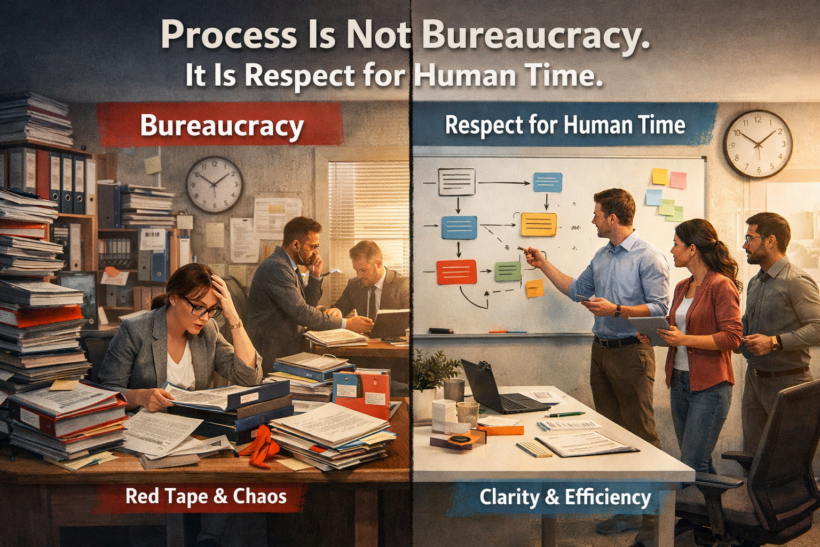
Bureaucracy exists to protect authority. Process exists to protect people.
Bureaucracy grows by adding steps that justify power. Process grows by removing pain from work. Bureaucracy asks, “Who must approve?” Process asks, “Who must not suffer?”
A simple test reveals the truth. If a step exists only to display control, it is bureaucracy. If a step exists to prevent waste, it is process.
Good process answers three basic questions:
- Who needs what?
- By when?
- In what form?
When these are clear, friction drops. People stop guessing. They stop chasing. They stop apologizing. Work flows because expectations are visible.

A Factory Story That Explains Everything
In one manufacturing plant, dispatch delays were routine. Every evening, teams stayed late. Materials were missing. Documents were incomplete. Transporters waited. Managers raised their voices. Employees rushed. Errors multiplied.
Leadership framed this as a people problem. They asked for more ownership. They demanded faster execution.
The real issue was structural. There was no standard handover between planning and stores. Each planner shared information differently. Each store officer interpreted it differently. Every morning began with confusion.
A simple process was introduced. One dispatch sheet. One format. One cut-off time. One owner. No new software. No new roles. Only clarity.
Within two weeks, overtime reduced by more than half. Errors fell sharply. Dispatch became predictable. Stress disappeared.
No one worked harder. They worked in flow. The process did not add control. It removed friction. It gave people their evenings back.
Why Smart People Resist Process
Most professionals are capable. They solve problems quickly. They adapt. They take pride in thinking. As a result, they resist structure. They fear that process will kill creativity.
They are partly right. Rigid process kills thinking. Living process supports it.
A good process does not replace judgment. It removes noise. It ensures that routine work does not require constant decision-making. It handles the predictable so that humans can focus on the meaningful.
This principle is central to the Toyota Production System. Standards handle the routine. Humans handle exceptions.
How Process Increases Creativity
Creativity does not thrive in chaos. It thrives in clarity. When people spend their days searching for information or correcting errors, their energy is consumed by survival.
Google’s Project Aristotle found that psychological safety and role clarity matter more than talent.
Read the research.
Clarity creates confidence. Confidence enables experimentation. Process creates the conditions where imagination becomes useful.
Why Fast Organizations Are Process-Driven
Speed is not created by pressure. It is created by design.
Amazon emphasizes clear ownership and standard mechanisms.
Learn how Amazon builds systems.
Fast organizations are predictable. People know who does what. They see the next step. They do not chase status. Speed emerges from structure.

Process as a Leadership Discipline
Designing process is not an administrative task. It is a leadership discipline.
Leaders shape experience. They decide whether work feels calm or chaotic. Every vague instruction becomes a burden on human time. Every unclear role becomes anxiety.
Great leaders ask different questions:
- Where does work get stuck?
- Where do people wait?
- Where do errors repeat?
- Where does stress spike?
Their response is not pressure. It is architecture.
A Simple Framework
- Observe the work.
- Identify friction points.
- Clarify interfaces.
- Standardize routine.
- Leave space for judgment.
What Leaders Can Do This Week
- Map one daily frustration with your team.
- Fix one confusing handover.
- Create one visible standard.
- Define one clear owner.
Conclusion
Every organization runs on invisible systems. These systems decide how people spend their days. They determine whether work feels purposeful or draining.
Process is the bridge between intent and experience.
When designed with care, it honors time. It protects energy. It creates space for thinking. It allows people to leave work with dignity.
Process is not bureaucracy. It is respect for human time.


 Ankit Joshi